




Table of Contents
- What is the forage actually providing?
- Everything Starts with Forage
- The Horse's Biological Requirements Haven't Changed. The Environment Has.
- Poor Grazing Doesn't Always Look Poor
- Fibre Does Far More Than Fill the Stomach
- Do Horses Need a Feed Balancer When Grass Quality Declines?
- Supporting the Foundations
- Practical Steps When Grass Growth Slows
- Why We Take a Forage-First Approach
- The Bottom Line
- References
- FAQs
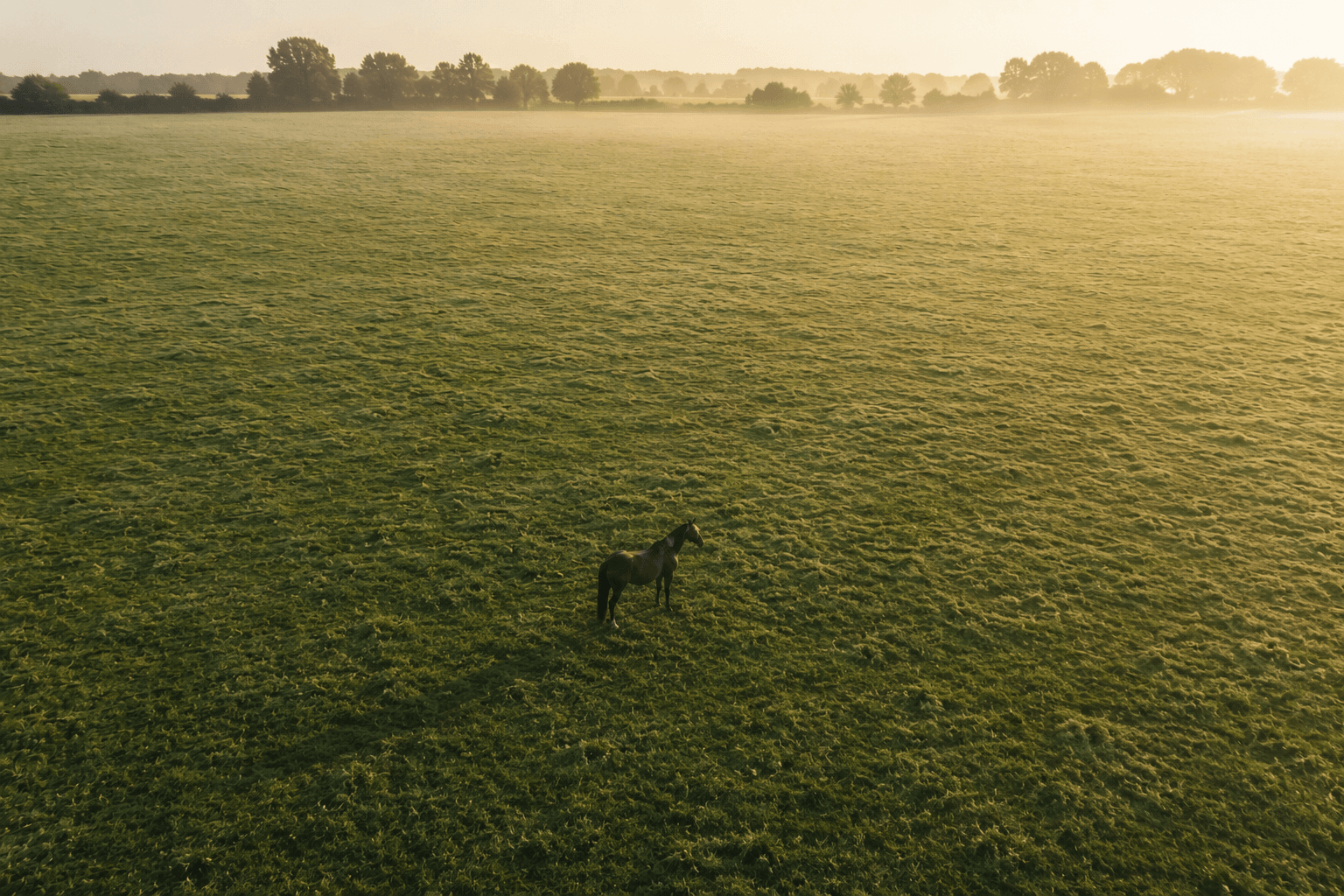
Forage has always been at the heart of horse nutrition.
Long before feed balancers, specialist supplements and carefully formulated feeds existed, horses evolved to survive on one thing above all else.
Fibre.
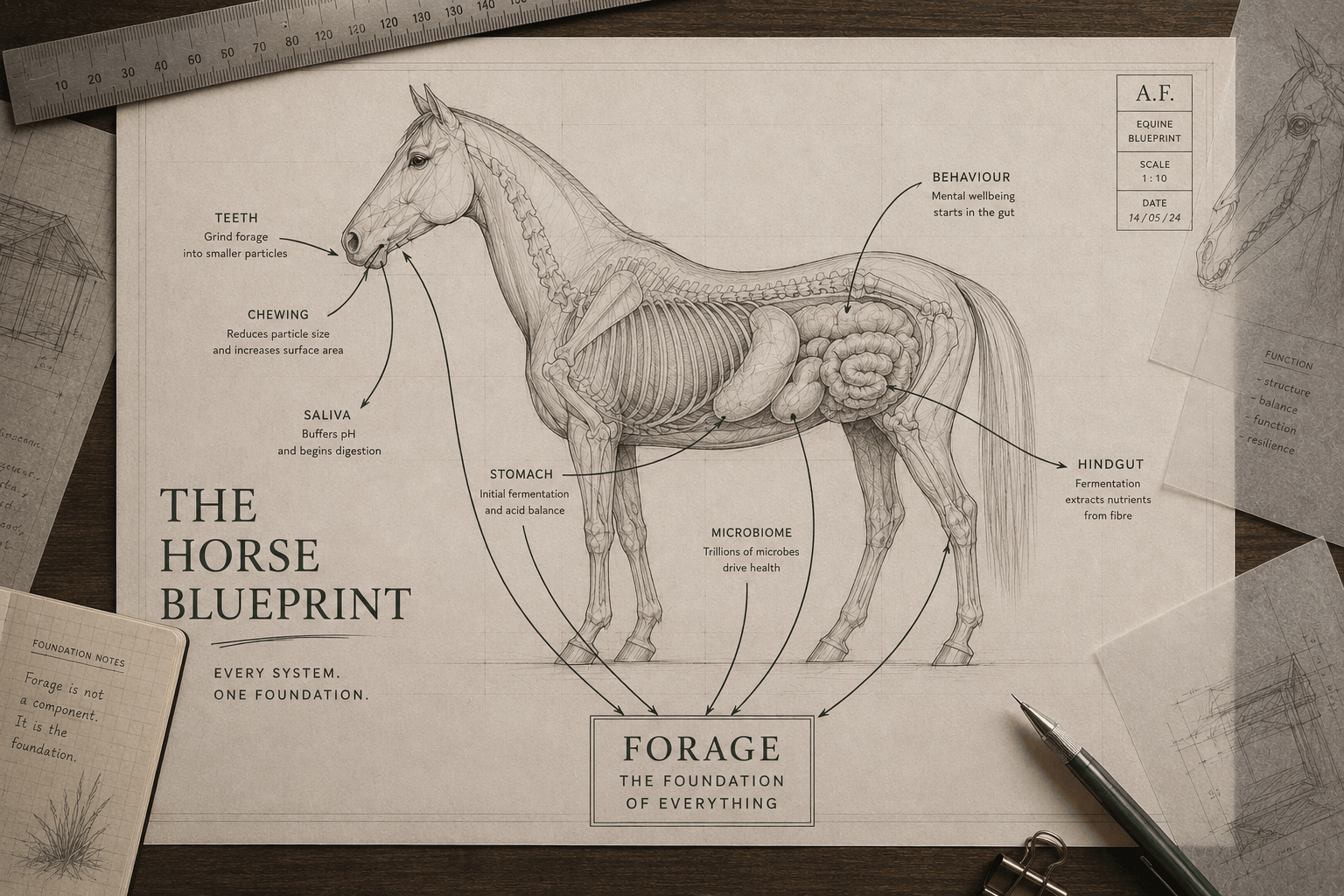
Everything about the horse, from its teeth and digestive tract to its hindgut microbiome and natural behaviour, is designed around the continuous consumption of forage.
That biology has not changed.
What has changed is the environment in which we keep horses.
Periods of prolonged dry weather, reduced rainfall, winter conditions, restricted grazing and modern pasture management can all influence the quality of the forage available. Some areas of the UK may officially experience drought, while others simply see slower grass growth or reduced nutritional value within their grazing. Whatever the cause, the nutritional pressures placed on the horse can become remarkably similar.
This is why understanding forage is so important.
It is easy to focus on what goes into the feed bucket, yet the biggest influence of horse nutrition is often what is already growing in the field or sitting in the hay net.
Before deciding whether your horse needs a feed balancer, digestive support or any other supplement, it is worth asking a more fundamental question.
What is the forage actually providing?
Every year horse owners ask questions such as:
- Does my horse need a feed balancer?
- Is there enough nutrition in my grass?
- Does poor grazing affect my horse's health?
- Is hay as nutritious as grass?
- Should I feed supplements when the grass stops growing?
- How does changing forage affect my horse's digestive health?
Although these appear to be different questions, they all begin in exactly the same place.
Understanding forage.
Once you understand how forage changes throughout the year, it becomes much easier to make informed decisions about the rest of your horse's diet. Rather than reacting to problems after they appear, you can build a nutritional foundation that supports long-term health, resilience and performance.
That philosophy sits at the heart of everything we do at Absolute Fundamentals.
We believe the strongest nutritional programmes do not begin with supplements.
They begin with understanding the horse.
They begin with forage.
Everything Starts with Forage
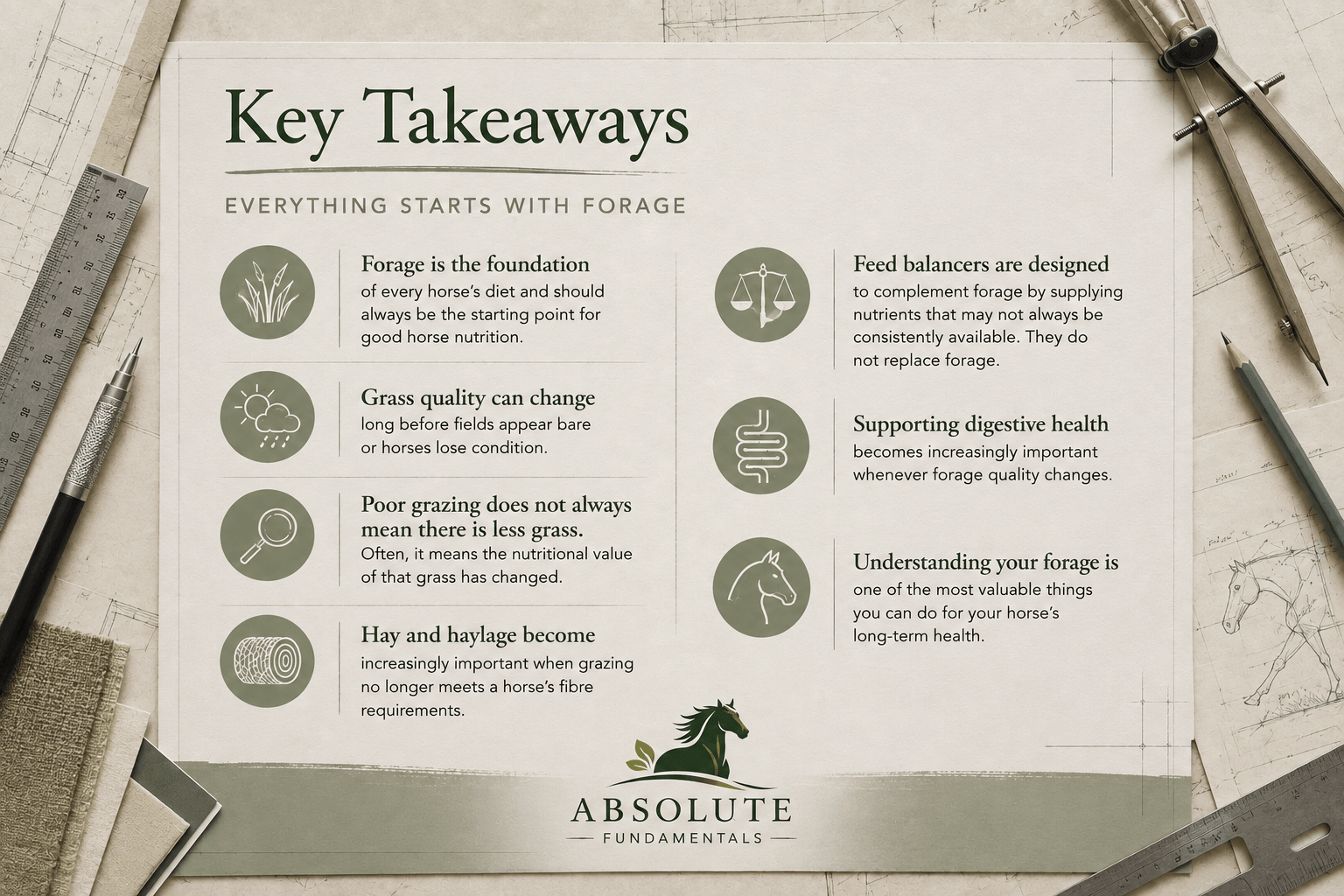
Before we talk about feed balancers, vitamins, minerals or specialist supplements, we have to start with the one thing every horse evolved to eat.
Forage.
Horses evolved over millions of years consuming small amounts of fibrous plant material almost continuously throughout the day.
Everything about the horse reflects that evolutionary history.
Its teeth are designed for prolonged chewing.
Its stomach is relatively small but produces acid continuously.
Its digestive tract relies upon a steady movement of fibre.
Its hindgut contains a vast and highly specialised microbial community capable of fermenting plant fibre into volatile fatty acids, providing a significant source of the horse's daily energy.
Even the horse's natural behaviour revolves around forage.
Given the opportunity, most horses will spend between 14 and 18 hours each day grazing.
Forage is not simply something that fills the stomach.
It is the nutritional, digestive and behavioural foundation upon which equine health is built.
When grazing is plentiful and of good quality, pasture provides much of that foundation.
When grazing becomes limited, hay or haylage should replace the fibre the horse would naturally consume.
Everything else simply complements that foundation.
Not replaces it.
Understanding this one principle changes the way we think about horse nutrition.
Rather than asking, "Which supplement should I feed?", the better question is:
"Is my horse's forage providing everything it needs?"
That question sits at the heart of good nutritional management.
The Horse's Biological Requirements Haven't Changed. The Environment Has.
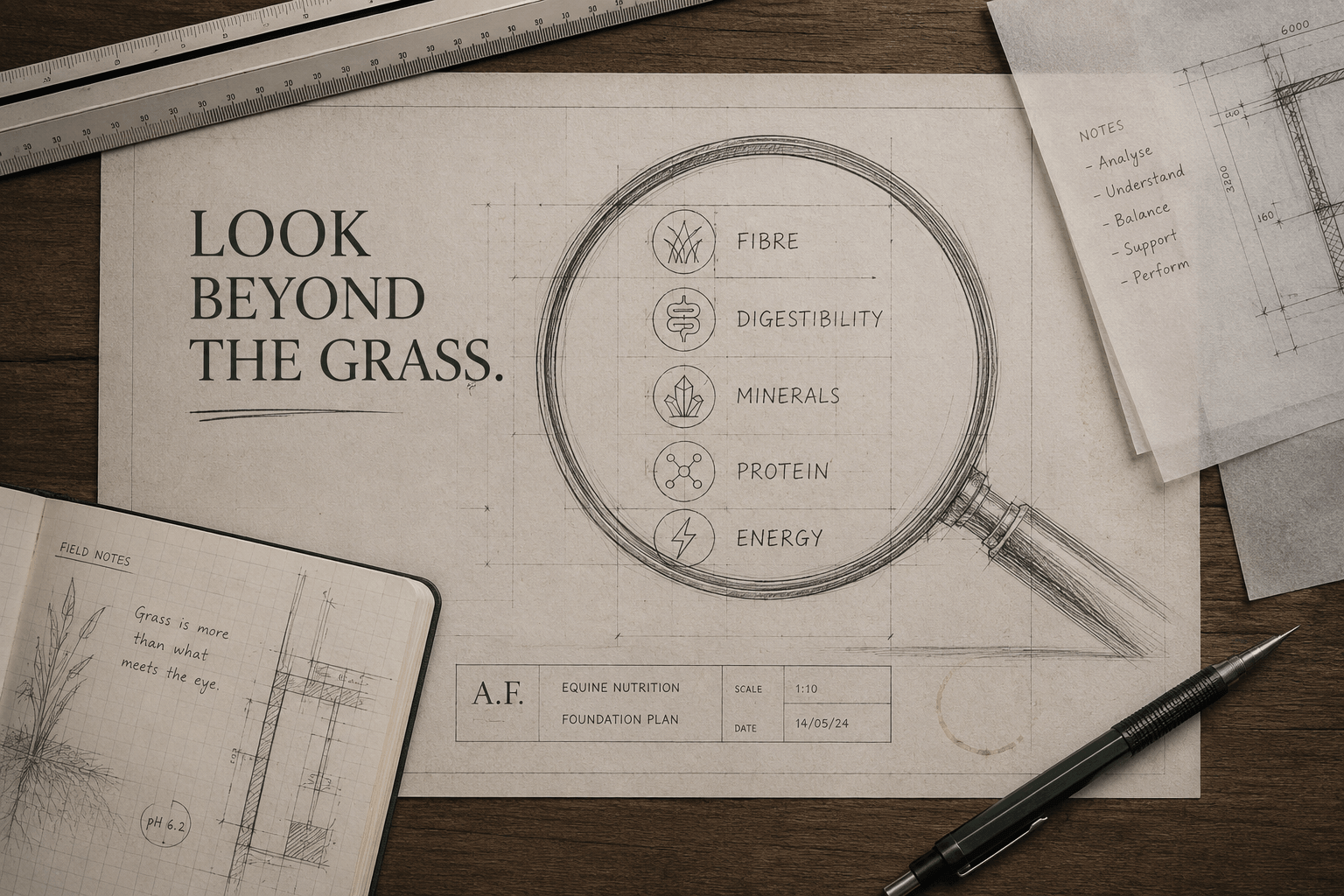
They still evolved to consume fibre almost continuously.
They still depend upon a healthy hindgut microbiome.
They still require consistent access to forage to support digestive function, behaviour and overall health.
What has changed is the environment in which we keep them.
Pasture is often managed more intensively.
Horses may spend longer periods on restricted grazing.
Weather patterns are becoming increasingly unpredictable.
Periods of prolonged dry weather, reduced rainfall, heavy winter conditions and seasonal fluctuations can all influence the quality and availability of forage.
One of the biggest misconceptions is that horse nutrition challenges only begin once fields turn brown or grazing becomes obviously sparse.
In reality, forage quality often begins changing long before the paddock looks dramatically different.
As rainfall decreases and temperatures rise, grass growth slows.
Plants mature differently.
Digestibility may decline.
Protein levels may reduce, and the concentrations of some nutrients can change depending on grass species, soil conditions and stage of growth.
It is easy to assume that because a field still looks green, little has changed.
However, the nutritional value of grass is influenced not only by what we can see above ground, but also by rainfall, soil moisture, plant maturity and ongoing growth.
Grass that has stopped actively growing can differ substantially in digestibility and nutritional profile from fresh, actively growing pasture, even if the field still appears well covered.
To the horse owner, there may still appear to be plenty of grazing.
To the horse, however, the nutritional value of that forage may no longer be what it was only a few weeks earlier.
That distinction matters.
Because nutrition is not measured by what a horse has available to eat.
It is measured by what that forage is actually capable of providing.
Poor Grazing Doesn't Always Look Poor
One of the most common misconceptions in horse nutrition is that a field covered in grass must automatically provide everything a horse needs.
Unfortunately, nutrition is rarely that simple.
Two paddocks can look almost identical while offering very different nutritional value.
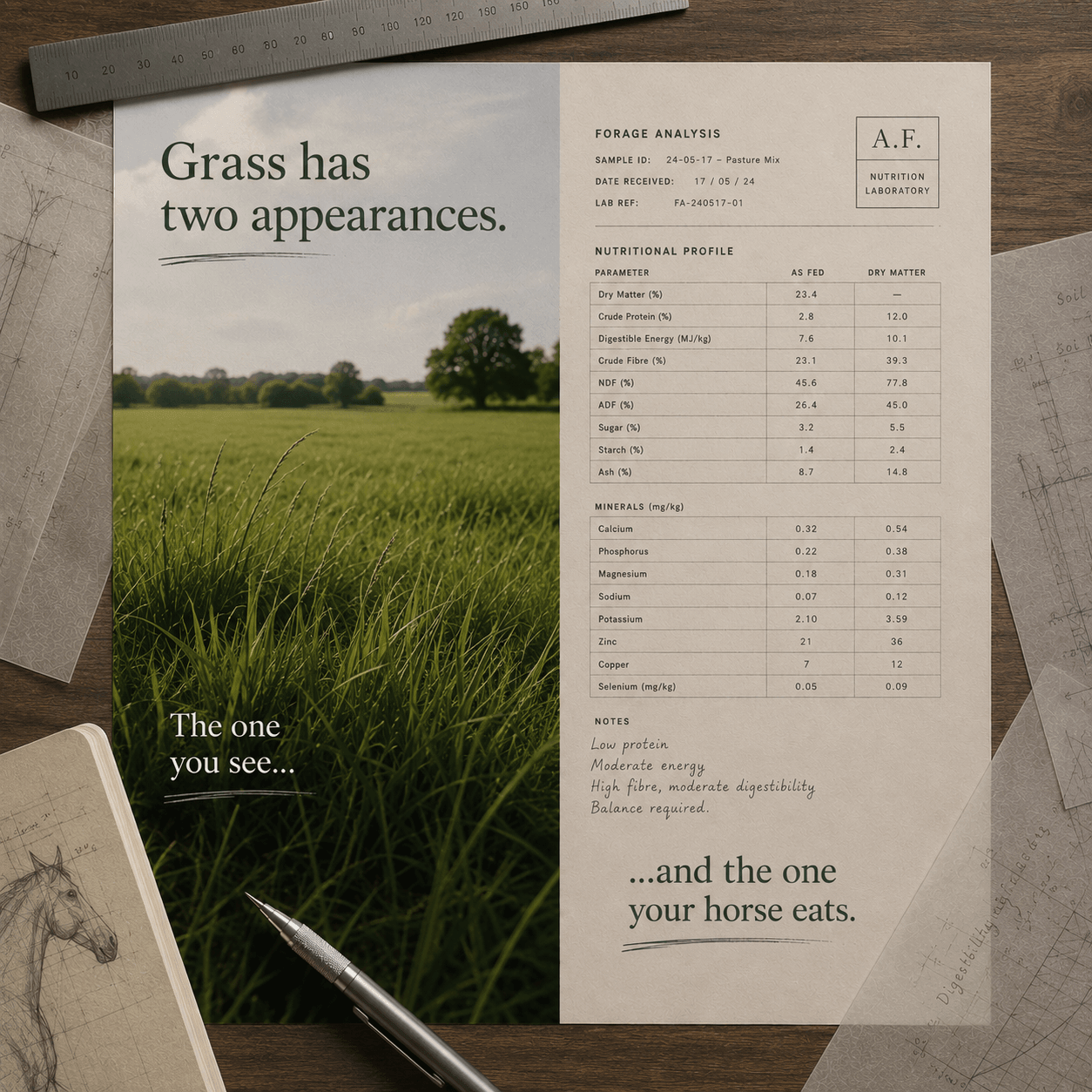
Grass species.
Soil health.
Rainfall.
Temperature.
Plant maturity.
Field management.
Fertiliser history.
Water availability.
Every one of these factors influences forage quality.
This is one of the reasons why horse nutrition can never be judged by appearance alone.
A field that appears healthy may be producing grass that has slowed its growth significantly.
Another field with less visible grass may actually be producing younger, more digestible forage.
Looking at a paddock tells us surprisingly little about its nutritional value.
Periods of prolonged dry weather place additional nutritional pressure on grazing systems.
Grass continues to mature.
Growth slows.
Digestibility changes.
The nutritional profile of the forage can gradually become less consistent.
The horse may still be eating.
It may even appear satisfied.
But that does not necessarily mean it is receiving the same nutritional value as it was earlier in the season.
This is why experienced horse owners increasingly look beyond the quantity of grass available.
Instead, they ask a much more useful question.
"What is this forage actually providing?"
That shift in thinking often changes the way the rest of the diet is approached.
Fibre Does Far More Than Fill the Stomach
Forage is often thought of simply as something that keeps horses occupied between feeds.
In reality, fibre performs an extraordinary number of biological functions.
Every mouthful of forage stimulates chewing.
Chewing encourages saliva production.
Saliva helps buffer the acidic environment within the stomach.
As forage moves through the digestive tract, it eventually reaches the hindgut, home to billions of bacteria, fungi and other microorganisms that work together to ferment plant fibre.
This remarkable microbial community, known as the hindgut microbiome, converts fibre into volatile fatty acids, providing a significant proportion of the horse's daily energy requirements while supporting normal digestive function.
The microbiome is not static.
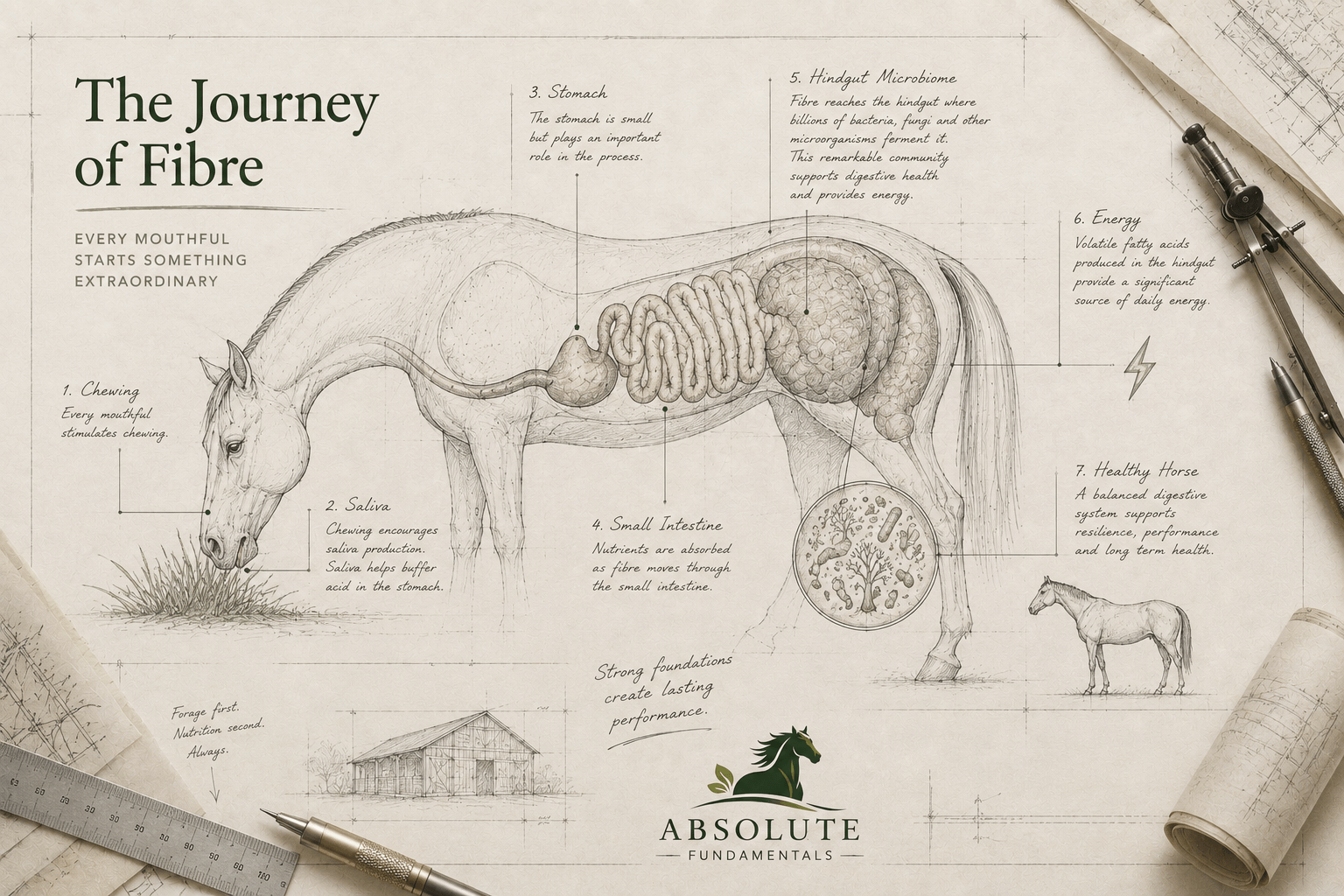
It continually adapts to the diet presented to it.
When forage changes, the microbial population also changes.
Most of the time, those adaptations happen naturally.
However, rapid or significant changes in forage quality can place additional demands on this delicate ecosystem.
For that reason, the hindgut microbiome functions best when fibre intake and forage quality remain as consistent as possible.
Supporting digestive health is therefore about much more than avoiding digestive upset.
It is about maintaining one of the horse's most important biological systems.
When we understand the role forage plays within that system, we begin to appreciate why every nutritional decision should start with fibre rather than the feed bucket.
Do Horses Need a Feed Balancer When Grass Quality Declines?
This is one of the questions we hear most often.
The honest answer is that there is no single response that applies to every horse.
It depends on the horse.
It depends on the forage.
And it depends on whether the nutrients provided by that forage continue to meet the horse's nutritional requirements.
That is an important distinction.
A feed balancer should never be viewed as a replacement for forage.
It cannot replace fibre.
It cannot replace chewing.
It cannot replace the complex relationship between the horse and its hindgut microbiome.
Its role is entirely different.
A well-formulated feed balancer is designed to complement forage by helping provide essential vitamins, minerals and trace elements that may not always be consistently supplied by grazing, hay or haylage.
When forage quality is high and the wider diet is appropriately balanced, relatively little additional support may be required.
However, as forage quality becomes less predictable, the nutritional contribution of the rest of the diet often becomes increasingly important.
This is why horse nutrition should always begin with the forage itself.
Only once the forage has been considered should decisions be made about what, if anything, needs to complement it.
If you would like to understand how to assess the quality of a feed balancer itself, read our guide How to Choose the Best Feed Balancer for Your Horse, where we explain what separates a thoughtfully formulated balancer from one that simply contains a long list of ingredients.
Supporting the Foundations
Understanding that forage comes first also changes the way we think about supplements.
Too often, supplements are viewed as solutions to individual problems.
Joint supplement for stiffness.
Digestive supplement for droppings.
Skin supplement for the coat.
Hoof supplement for the feet.
Whilst targeted nutritional support certainly has its place, long-term health is rarely built by addressing isolated symptoms.
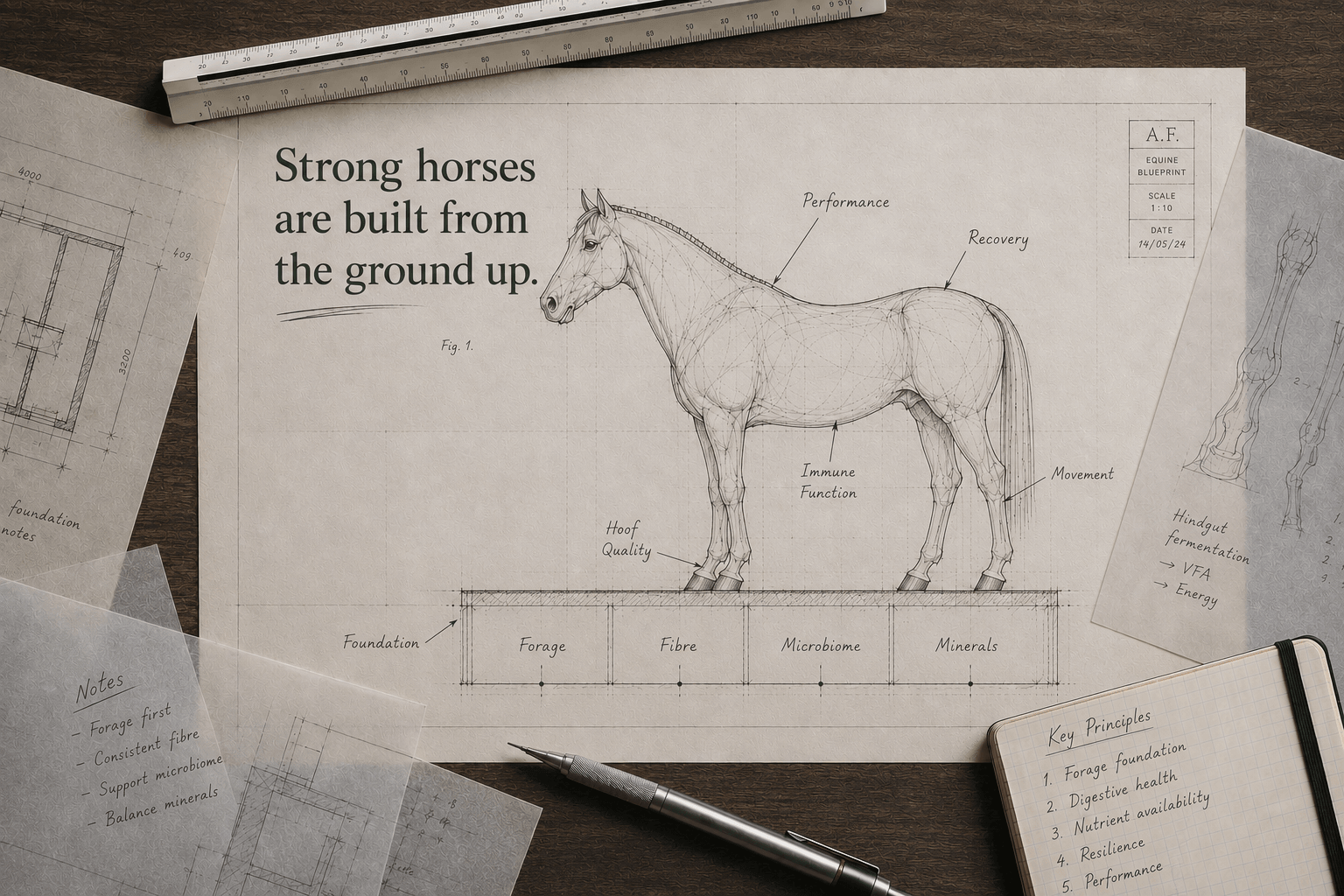
It is built by strengthening the nutritional foundations upon which every biological system depends.
When forage quality changes, those foundations can come under greater nutritional pressure.
The horse's requirement for nutrients does not suddenly change because rainfall has reduced or grass growth has slowed.
Its biological requirements remain remarkably consistent.
What changes is the nutritional value of the forage available to meet those requirements.
That is why we believe nutritional support should always begin with the foundation.
Before asking what additional supplement a horse might need, it is worth asking whether the nutritional building blocks are already in place.
Supporting the horse's vitamin and mineral intake.
Supporting digestive function.
Supporting the hindgut microbiome.
Supporting connective tissues, muscles and joints.
These are not separate objectives.
They are all interconnected.
Just as a house depends upon strong foundations before the roof is added, long-term equine health depends upon getting the basics consistently right.
Practical Steps When Grass Growth Slows
Periods of reduced grass growth provide an opportunity to reassess the horse's nutritional programme before problems develop.
Rather than waiting for condition, hoof quality or digestive function to deteriorate, it is often more effective to review the diet proactively.
Consider asking yourself the following questions.
- Is my horse still consuming enough forage each day?
- Has the quality of the grazing changed over recent weeks?
- Does additional hay or haylage need to be introduced?
- Is my horse maintaining an appropriate body condition score?
- Has the balance of vitamins and minerals within the diet changed?
- Have there been any changes in droppings, behaviour or appetite that might suggest the diet needs reviewing?
- Have any dietary changes been introduced gradually enough to allow the digestive system time to adapt?
Small adjustments made early are often far more effective than large corrections made later.
The goal is not simply to respond when problems become obvious.
It is to support the horse before nutritional pressures begin to affect health and performance.
Why We Take a Forage-First Approach
We believe it begins with understanding the horse.
Every formulation begins with a single question.
What would nature have expected this horse to eat?
The answer is always the same.
Forage.
From there, we considered what modern horses experience that their wild counterparts often did not.
Restricted grazing.
Managed pasture.
Conserved forage.
Seasonal changes.
Periods of prolonged dry weather.
Intensive training.
Competition schedules.
Travel.
Recovery.
Each of these influences the nutritional environment in which today's horses live.
Absolute Fundamentals was built by bringing together the expertise of experienced equine nutritionists, medical herbalists and naturopaths.
Not because these disciplines compete with one another.
But because no single discipline has all the answers.
Nutritional science provides the essential nutrients the horse requires to support normal biological function.
Botanical medicine helps identify carefully selected plant-based ingredients, drawing on both traditional knowledge and modern research.
Naturopathy reminds us to view the horse as an interconnected biological system, where long-term health is built by supporting balance, resilience and normal physiological function rather than chasing individual symptoms.
Together, these disciplines shaped something different.
Not another collection of supplements, but a nutritional system designed to work alongside the horse's natural diet.
CORE provides the nutritional foundation, helping support the vitamins, minerals and trace nutrients that forage and the wider diet may not consistently supply.
FLOW complements that foundation by supporting digestive health and the hindgut microbiome, recognising that good nutrition depends on effective digestion and nutrient utilisation.
MOVE completes the system by providing targeted nutritional support for joints, muscles and connective tissues, complementing rather than competing with the role of CORE and FLOW.
None of these products replace forage.
They never could.
They are designed to complement the horse's natural diet, strengthening the nutritional foundations upon which long-term health depends.
Our ambition has never been to build the biggest supplement range.
It has been to change the way horse owners think about horse nutrition.
Because better horse nutrition starts with better understanding.
And when understanding improves, better decisions follow.
When better decisions become daily habits, horses benefit.
The Bottom Line
Every season teaches us something about horse nutrition.
Spring reminds us how quickly fresh grazing can change.
Summer reminds us that grass is not always as nutritious as it appears.
Autumn prepares us for conserved forage.
Winter reminds us how heavily we depend upon hay and haylage.
Yet throughout every season, one thing remains constant.
The horse's biological requirements have not changed.
Its digestive system still expects fibre.
Its hindgut microbiome still depends upon a consistent supply of forage.
Its nutritional requirements remain remarkably stable, even when the environment around it changes.
That is why understanding forage is so important.
Good horse nutrition does not begin with choosing a supplement.
It begins with understanding what the horse is already eating.
When forage quality changes, our nutritional decisions should change with it.
Not because forage has become less important.
But because it has become even more important.
At Absolute Fundamentals, we believe that everything else should support the biology that nature designed.
Before every supplement.
Before every feeding plan.
Before every horse nutrition decision.
There is one question worth asking.
What is the forage providing?
Because when we answer that question first, everything else becomes much easier.
Forage first. Always.
CORE + MOVE + FLOW
£95.00
A Three-Pillar Approach to Supporting the Whole Horse CORE is where everything starts. MOVE is where structure is supported. FLOW is where the system functions properly. Because the horse does not operate in parts. Nutrition, digestion, structure, and movement are… read more

References
British Equine Veterinary Association (BEVA). Feeding and Nutrition Resources.
British Horse Society (BHS). Horse Feeding Advice and Best Practice Guidance.
Harris, P., Ellis, A. & Fradinho, M. Equine Applied and Clinical Nutrition. Elsevier.
National Research Council (2007). Nutrient Requirements of Horses. Sixth Revised Edition. National Academies Press.
Pagan, J. D. Advances in Equine Nutrition.
Perricone, V., et al. Research relating to the equine gastrointestinal microbiome and nutritional management.
Schoster, A., et al. Research investigating the equine hindgut microbiome and gastrointestinal health.
FAQs
Why is forage the foundation of horse nutrition?
Forage is the natural diet of the horse. It supplies the fibre needed to support digestive health, encourages normal chewing behaviour, helps buffer stomach acid through saliva production and provides the energy source for the hindgut microbiome. Every feeding programme should begin by considering the quality and quantity of forage available.
Does reduced rainfall affect the nutritional value of grass?
It can.
Periods of prolonged dry weather and reduced rainfall often slow grass growth and can influence digestibility and nutrient composition. The extent of those changes depends on factors such as grass species, soil type, stage of growth and local environmental conditions.
Can horses become nutritionally deficient on poor grazing?
They can.
A horse may consume plenty of grass while still receiving lower levels of certain nutrients if forage quality has declined. This is why assessing forage quality is often more valuable than judging pasture by appearance alone.
Is hay better than poor grass?
Not necessarily.
Good quality hay can provide a more consistent source of fibre than poor-quality grazing, but every forage source is different. The nutritional value of both hay and grass depends on when it was harvested or grazed, how it has been managed and how it has been stored.
Does every horse need a feed balancer?
No.
The need for a feed balancer depends on the individual horse, the forage being fed and the rest of the diet. Feed balancers are designed to complement forage by helping provide nutrients that may not always be consistently available. They should never be viewed as a replacement for good-quality forage.
For a detailed guide to assessing feed balancers, read How to Choose the Best Feed Balancer for Your Horse.
Can supplements replace hay or grass?
No.
Supplements are designed to complement the diet, not replace it. They cannot replace the fibre, chewing activity or digestive function that forage provides
Why is digestive health affected when forage changes?
The horse's hindgut contains billions of microorganisms that help ferment fibre. Changes in forage quality or sudden dietary changes require those microbial populations to adapt. Supporting consistent fibre intake helps maintain normal digestive function during these periods.
What is the hindgut microbiome?
The hindgut microbiome is the complex community of bacteria, fungi and other microorganisms that live within the horse's caecum and colon. These microbes ferment plant fibre to produce volatile fatty acids, which provide a significant source of energy for the horse while supporting normal digestive function.
Why does Absolute Fundamentals recommend a forage-first approach?
Because horse biology has not changed.
Everything we do starts with forage. Rather than creating products to tackle individual problems, we developed a Three Pillar Nutritional System that complements the horse's natural diet.
CORE supports the nutritional foundation, FLOW supports digestive health and the hindgut microbiome, and MOVE provides targeted support for joints, muscles and connective tissues.
None of these products replace forage.
They are designed to complement it.