






Table of Contents
- What is a Feed Balancer?
- Why a long ingredients list doesn't necessarily mean better nutrition
- Look beyond the front of the bag
- Why Nutrient Form Matters
- Why ingredient quality matters
- Feed grade or premium manufacture?
- Can one product really do everything?
- Ask better questions - Questions every horse owner should ask
- Absolute Fundamentals philosophy
- The bottom line
- FAQs
What is a Feed Balancer?
Not all feed balancers are created equal. Discover how to assess ingredient quality, bioavailability, formulation philosophy and manufacturing standards of a feed balancer so you can make informed decisions about your horse's nutrition.
Feed balancers have become one of the most popular nutritional products in the equine industry. Yet they are also one of the least understood.
Many horse owners type phrases such as "best feed balancer for horses", "what is the best horse feed balancer?" or "which horse feed balancer should I choose?" into Google.
They're understandable questions.
But they may not be the right ones.
The better question isn't "Which is the best feed balancer?" It's "How do I judge whether a feed balancer is actually good?"
Feed balancers are designed to provide concentrated nutrition rather than calories. Unlike compound feeds, a balancer is intended to deliver vitamins, minerals and other nutrients in a relatively small daily serving. Because that serving is small, every gram of the formulation matters. Every ingredient occupies valuable space. Every formulation choice has consequences.
Almost every product promises healthier hooves, better coats, stronger joints, improved digestion and optimal nutrition.
The difficult part isn't finding feed balancers.
It's knowing how to judge one.
Most look impressive.
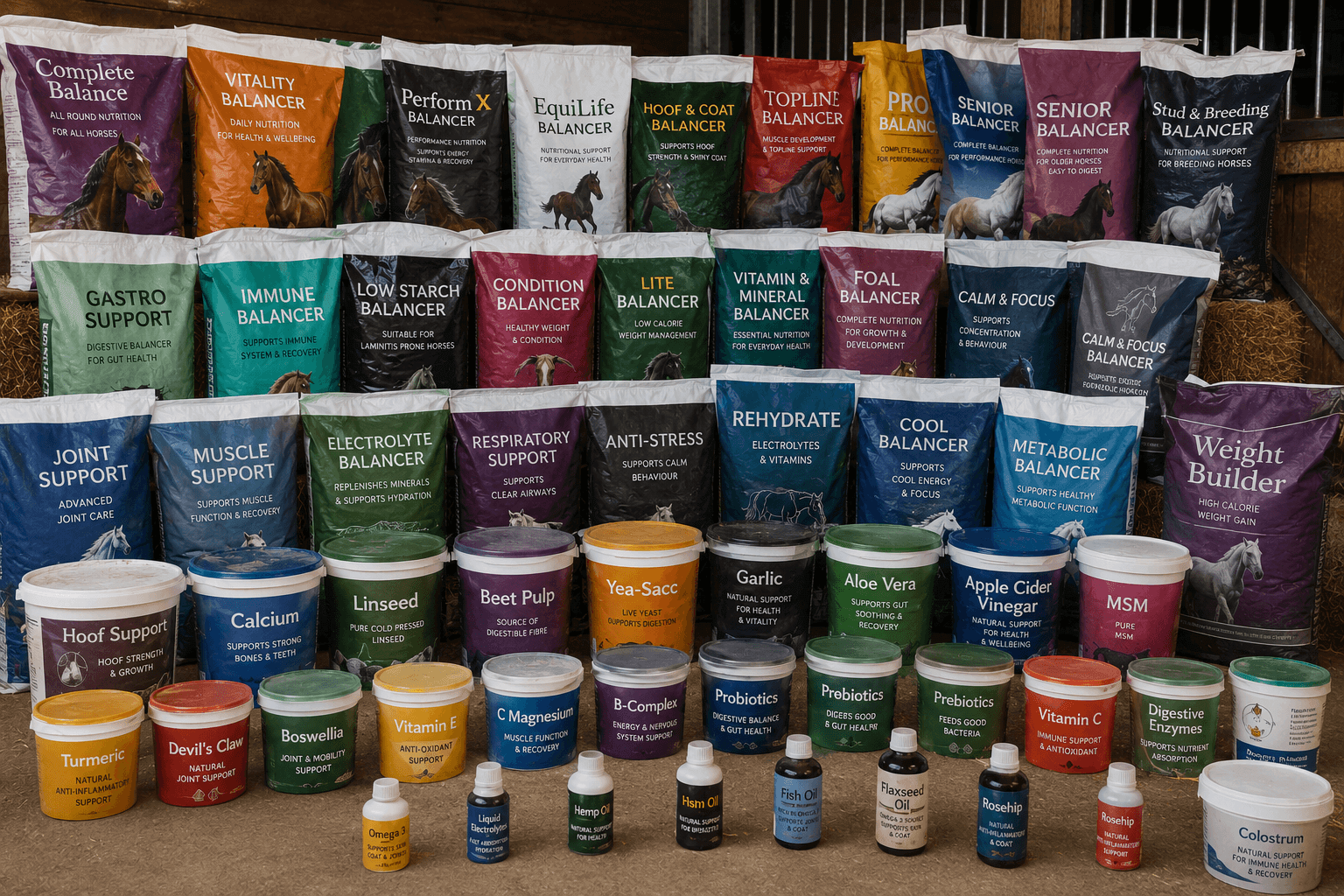
Many contain long lists of vitamins, minerals, amino acids, probiotics, prebiotics, herbs and other functional ingredients.
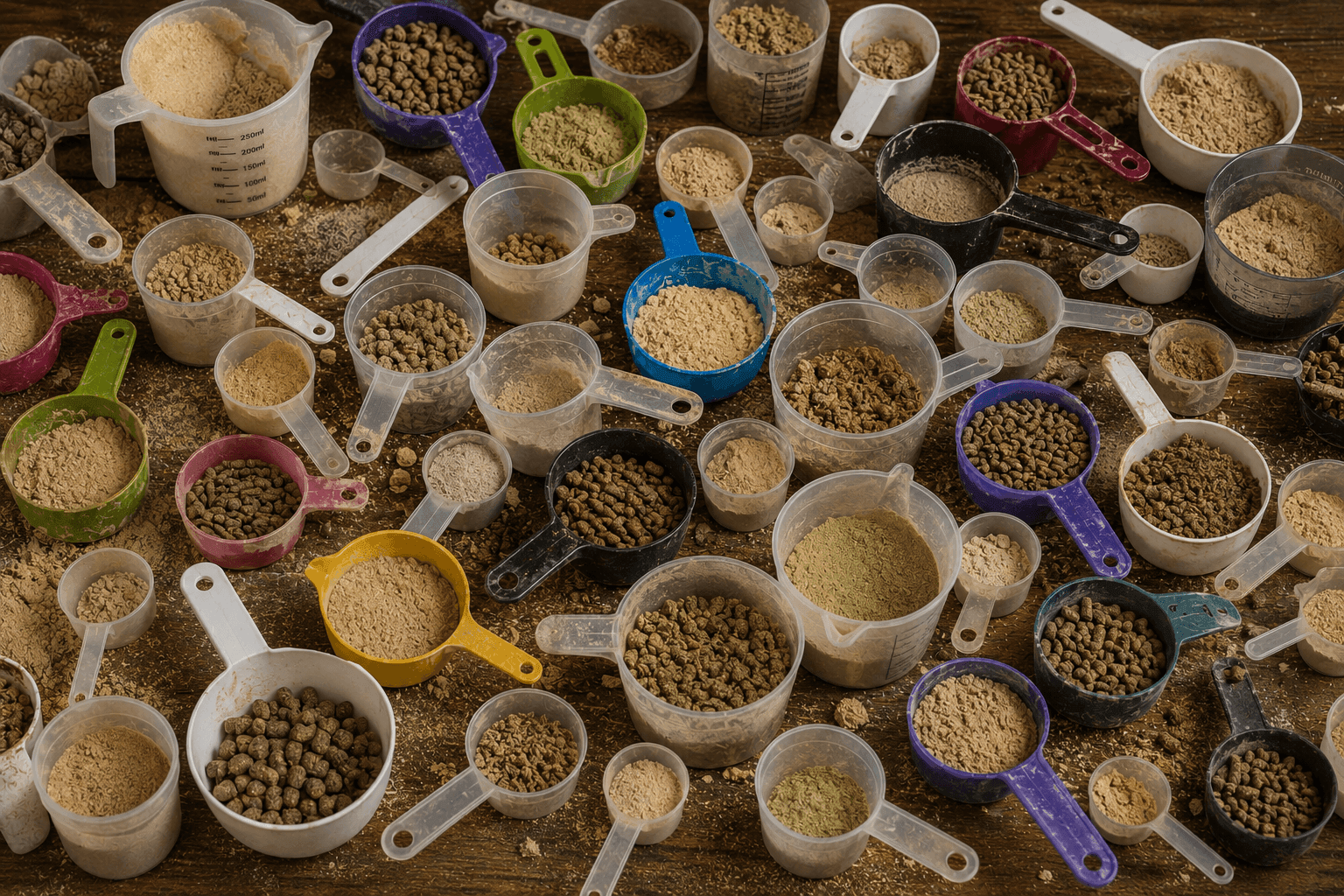
Some even claim to support almost every system within the horse's body.
So how do you know which one is genuinely right for your horse?
The truth is that a feed balancer should never be judged by how impressive its label looks.
It should be judged by the quality of its formulation, the quality of its ingredients and, ultimately, by what your horse can actually absorb, utilise and benefit from.
Why a long ingredients list doesn't necessarily mean better nutrition
One of the biggest misconceptions in equine nutrition is that more ingredients automatically mean a better product.
They don't.
Ingredient Lists don't tell the whole story
A long ingredients list tells you what has been included.
It doesn't tell you why it has been included.
It also does not establish the ingredient's stability, viability, bioavailability or effectiveness within the finished product.
It doesn't tell you how much has been included.
It also doesn't tell you whether the ingredient remains stable within the finished product, whether it is present at a meaningful inclusion level, how readily it can be utilised by the horse or whether it has been included at a level supported by evidence.
It certainly doesn't tell you how much your horse can actually absorb.
An ingredients list confirms presence. It does not, by itself, establish dose, stability, bioavailability or efficacy.
A well formulated supplement is not about how many ingredients can fit on the label.
It is about selecting the right ingredients, in the right forms, at meaningful inclusion levels, for a clearly defined purpose.
Every ingredient should earn its place.
Look beyond the front of the bag
Many horse owners assume that because a product is called a feed balancer, every ingredient inside it has been chosen primarily to improve the horse's nutrition.
That isn't always the case.
Many feed balancers contain ingredients such as wheat feed, beet pulp, soy hulls, oat feed and other fibre based ingredients. These ingredients all have recognised uses within equine nutrition and can make a valuable contribution depending on the purpose of the formulation.
The important question is not whether these ingredients are good or bad.
The important question is why they are there.
There is absolutely nothing wrong with that.
However, horse owners should understand the difference between ingredients that primarily provide the structure of the product and those included specifically to deliver targeted nutritional support.
It is easy to be reassured by a long ingredients list and assume that more ingredients mean better nutrition.
In reality, the nutritional value of a balancer depends far more on the quality of its formulation, the forms of nutrients selected and whether those nutrients are supplied at meaningful levels than on the number of ingredients listed on the label.
A horse does not become healthier simply because a product contains more ingredients.
A horse becomes healthier because it receives the nutrients it needs, in forms it can readily absorb and utilise.
That is why we believe horse owners should look beyond the front of the bag and ask a simple question.
"Which ingredients are there to provide the nutritional benefit I am buying this product for?"
Why Nutrient Form Matters
Most horse owners assume that if two products both contain copper, zinc or selenium, they must be providing the same nutritional support.
Unfortunately, nutrition is rarely that simple.
The chemical form in which a nutrient is supplied has a significant influence on how efficiently it can be absorbed and utilised by the horse.
Think of it like feeding hay.
You could place 20 kilograms of hay in front of your horse every day.
If your horse could only digest half of it, would you really say they had received 20 kilograms of nutrition?
Of course not.
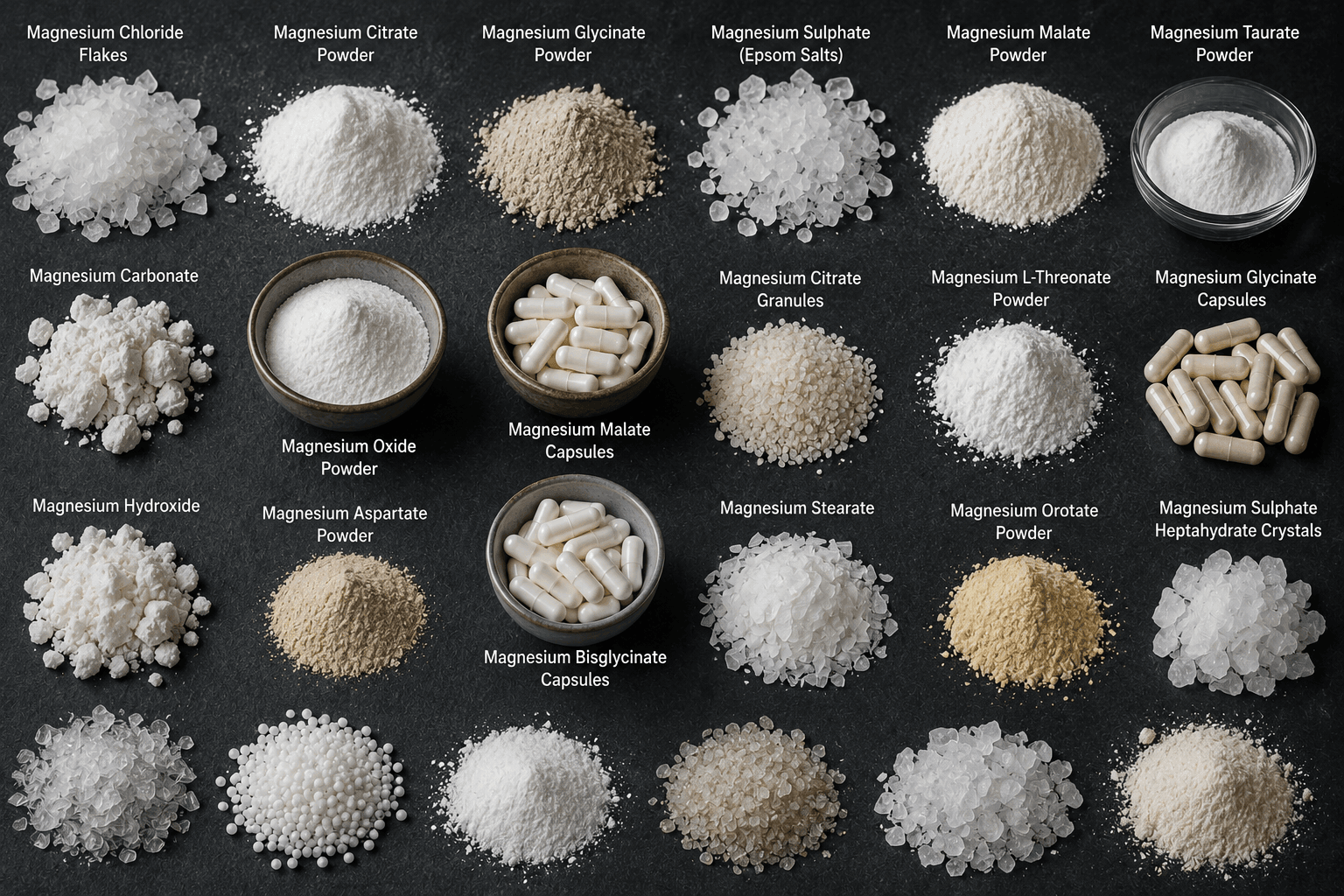
Minerals work in exactly the same way.
Two products may contain identical levels of copper, zinc or selenium on the label, yet the forms used can influence how much is ultimately available for the horse to absorb and use.
That is what nutritionists mean when they talk about bioavailability.
Your horse doesn't benefit from what goes into the feed scoop. Your horse benefits from what he/she can digest, absorb, retain and use.
It isn't simply about how much of a nutrient appears on the label.
It is about how much your horse can digest, absorb, retain or utilise for the purpose for which it was included.
Many organic and amino acid chelated mineral sources have demonstrated advantages in absorption, retention or biological activity compared with some traditional inorganic sources. However, results are not uniform, and any advantage depends on the individual mineral, the precise source used, the overall diet and the horse.
A supplement isn't measured simply by what it contains.
It is measured by what your horse can actually use.
The most expensive nutrient in the world is the one your horse can't absorb.
Why ingredient quality matters
Every formulation is only as good as the raw materials used to create it.
Two products can appear remarkably similar on paper while being formulated from very different ingredients.
Higher quality raw materials generally cost more.
More bioavailable mineral forms generally cost more.
Greater traceability and tighter quality assurance cost more.
Every manufacturer makes decisions about ingredient selection.
Those decisions influence not only the nutritional profile of the product but also its consistency, purity, traceability and overall quality.
Ultimately, every formulation is a series of carefully balanced decisions.
Every formulation has finite space within the recommended daily feeding rate. Every ingredient included inevitably reduces the space available for something else.
Every formulation therefore represents a balance between nutritional science, ingredient quality, manufacturing practicality, palatability and cost.
The question is not simply whether good ingredients have been included.
The question is which compromises were made during formulation and why.
Every formulation reflects a series of priorities. Some manufacturers prioritise cost. Others prioritise manufacturing efficiency, shelf life or convenience. Others prioritise ingredient quality and nutritional philosophy. None of those choices are inherently right or wrong, but understanding those priorities often tells you far more about a product than the front of the packaging ever will.
Feed grade or premium manufacture?
Many equine supplements are manufactured to recognised feed industry standards, providing an important framework for safety and compliance.
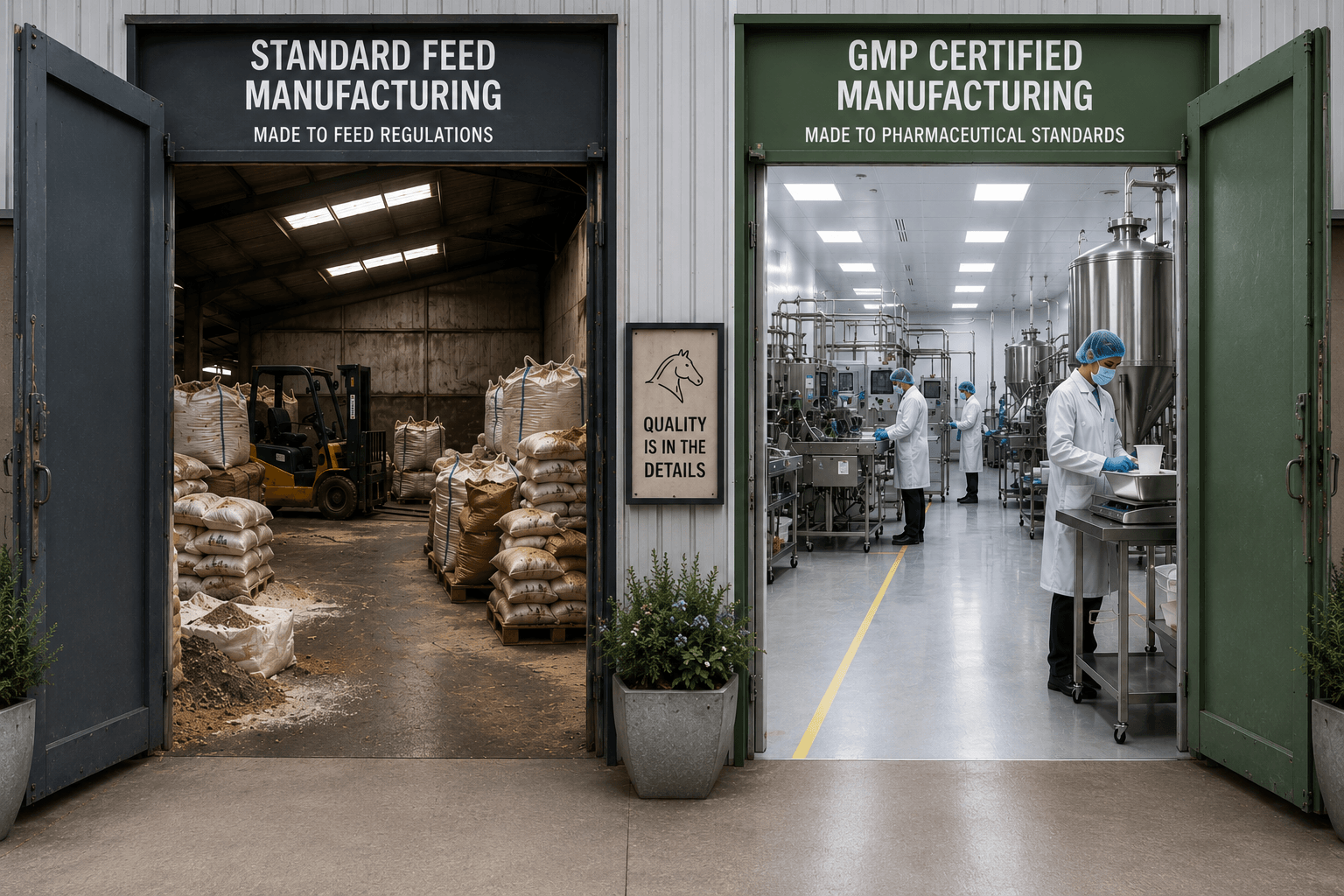
Some manufacturers choose to go beyond those requirements by sourcing higher specification raw materials or manufacturing within facilities operating to pharmaceutical or human GMP quality systems.
This does not automatically prove that a product will deliver a better nutritional or clinical outcome for every horse. What it does provide is an additional quality assurance framework, with tighter controls surrounding raw material specifications, supplier approval, traceability, batch consistency, documentation and the management of manufacturing risks. For owners feeding a product every day, those are important considerations.
Can one product really do everything?
This is one of the biggest questions horse owners should ask.
Many feed balancers claim to support nutrition, hoof quality, coat condition, digestive health, joints, muscles, immune function, metabolism and recovery, all within a single daily serving.
Broad nutritional support is an attractive concept.
However, every formulation has practical limits.
Every ingredient occupies space within the daily feeding rate.
Every additional claim requires room for additional ingredients.
Every formulation therefore involves compromise.
The question is not whether one product can contain many ingredients.
The question is whether every ingredient is present for a clear reason, at a meaningful inclusion level and in a form that allows the horse to make best use of it.
In some situations, separating nutrition into targeted formulations allows each product to focus entirely on its intended role without competing for formulation space with multiple other objectives.
This does not mean that every single-product balancer is inadequate. It explains why we chose a targeted system and why we believe that structure gives us greater control over the purpose and inclusion level of each ingredient.
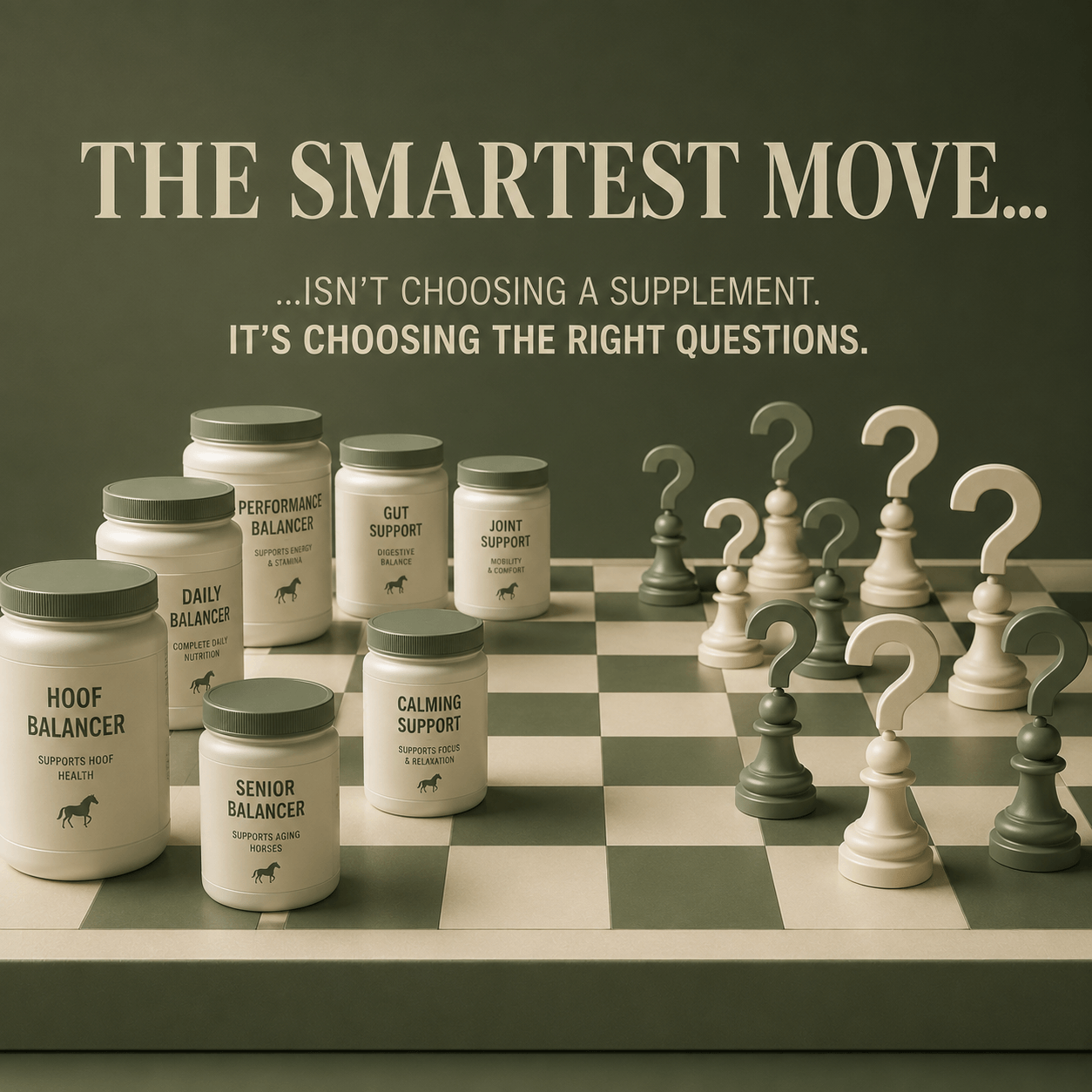
Ask better questions - Questions every horse owner should ask
Choosing feed balancers isn't about finding the biggest label or the longest ingredients list.
It is about understanding what sits behind the formulation.
Before you buy, ask yourself:
- Why has each ingredient been included?
- Does every ingredient contribute meaningfully to the nutritional objective of the product?
- Are functional ingredient inclusion rates declared?
- What forms of vitamins and minerals are being used?
- How are quality and consistency maintained?
- What evidence supports the formulation?
- Is the product driven primarily by nutritional science or by marketing?
- Does the formulation have a clear philosophy or is it attempting to satisfy every possible claim?
The answers to those questions will usually tell you far more than the front of the packaging ever will.
Absolute Fundamentals philosophy
At Absolute Fundamentals, we didn't begin with a target price.
We began with a question.
"What gives the horse the greatest opportunity to thrive?"
That philosophy guided every decision we made.
Every ingredient had to justify its place.
We never started with a cost and worked backwards.
We started with the horse and asked what they genuinely needed.
Only then did we decide what it would cost to produce.
Where appropriate, we selected nutrient forms supported by evidence for their quality and bioavailability.
We focused on ingredient quality, meaningful inclusion levels and manufacturing consistency.
Rather than asking one product to support every aspect of the horse, we developed a system where each formulation has a clear purpose.
CORE provides the nutritional foundation.
FLOW supports digestive health and the gut microbiome.
MOVE supports joints, muscles and connective tissue.
Each formulation is designed around one clearly defined area of nutritional support.
Absolute Fundamentals brings together the expertise of experienced equine nutritionists, medical herbalists and naturopaths.
We do not believe these disciplines compete with one another.

We believe they complement one another.
Nutritional science provides the essential building blocks the horse needs to thrive.
Botanical medicine helps identify carefully selected plant based ingredients supported by both traditional knowledge and modern research.
Naturopathy encourages us to view the horse as a complete biological system, recognising that long term health is built by supporting balance, resilience and function rather than focusing on individual symptoms in isolation.
Together, these disciplines helped shape a nutritional system designed not simply to prevent deficiencies but to support long term health from the inside out.
The bottom line
There are many feed balancers available today.
Some are thoughtfully formulated.
Some simply satisfy the minimum expectations of the category.
As with every industry, quality varies enormously.
The best products are rarely defined by the length of their ingredients list or the boldness of their marketing.
They are defined by thoughtful formulation, carefully selected ingredients, meaningful nutritional science, manufacturing quality and a genuine commitment to the horse.
Ultimately, nutrition is not about filling a feed scoop.
It is about giving the horse the greatest opportunity to live a healthier, stronger and more resilient life.
That is the standard every horse owner should expect.
And it is the standard that guides every formulation we create at Absolute Fundamentals.
CORE + MOVE + FLOW
£95.00
A Three-Pillar Approach to Supporting the Whole Horse CORE is where everything starts. MOVE is where structure is supported. FLOW is where the system functions properly. Because the horse does not operate in parts. Nutrition, digestion, structure, and movement are… read more

Selected References
Gordon ME, Edwards MS, Sweeney CR, Jerina ML. Effects of added chelated trace minerals, organic selenium, yeast culture, direct-fed microbials, and Yucca schidigera extract in horses. Part I: Blood nutrient concentration and digestibility. Journal of Animal Science. 2013;91(8):3899-3908.
Perricone V, et al. The Role of Saccharomyces cerevisiae in Supporting Gut Health in Horses: An Updated Review on Its Effects on Digestibility and Intestinal and Fecal Microbiota. Animals. 2022;12:3475.
Schoster A, et al. The Safety, Tolerability and Efficacy of Probiotic Bacteria for Equine Use. Journal of Equine Veterinary Science. 2021.
National Research Council. Nutrient Requirements of Horses. 6th Revised Edition. National Academies Press. 2007.
FAQs
What is a feed balancer?
A feed balancer is a concentrated source of vitamins, minerals and other nutrients designed to complement a forage-based diet without adding significant calories.
Does every horse need a feed balancer?
Not every horse requires one. Whether a feed balancer is appropriate depends on the forage available, the horse's workload, age, health status and the rest of its diet.
What does bioavailability mean?
Bioavailability refers to how effectively a nutrient can be digested, absorbed, retained and utilised by the horse.
What are chelated minerals?
Chelated minerals are minerals bound to amino acids or other organic molecules. Some studies have shown advantages in absorption or retention compared with certain inorganic mineral sources, although this depends on the individual mineral and the overall diet.
Can one feed balancer support everything?
Many products attempt to support multiple body systems. However, every formulation has practical limits, and adding more ingredients does not necessarily improve nutritional value.
How do I compare two feed balancers?
Look beyond the marketing. Compare ingredient quality, nutrient forms, manufacturing standards, declared inclusion levels and the philosophy behind the formulation.
Why are manufacturing standards important?
Robust manufacturing standards help ensure consistency, traceability, quality control and product integrity from batch to batch.